
Hyper Focus: Mastering Hyperpigmentation in Skin of Color
CONTRIBUTORS: Dr. Lisa Ginn, MD
Overview
Dr. Lisa Ginn, a board-certified dermatologist practicing in Chevy Chase, MD, shares clinical insights from years of treating dyspigmentation in patients with skin of color.
Hyperpigmentation and hypopigmentation are more than cosmetic concerns. Conditions such as post-inflammatory hyperpigmentation (PIH), melasma, and acanthosis nigricans can be more common, persistent, and noticeable in melanin-rich skin, with effects that extend beyond physical appearance. Studies show that patients of color with visible skin conditions report higher rates of anxiety, depression, and low self-esteem, while many feel underserved by clinicians and mainstream skincare options.
Dr. Ginn explores culturally competent care, sun protection, and targeted treatment strategies for melasma, PIH, and acanthosis nigricans, emphasizing that successful treatment can support both skin health and overall well-being.
CULTURAL SKINCARE APPROACHES:
Cultural awareness is an important part of treating dyschromia, as both its presentation and psychological impact can vary across ethnicities. One growing example is Korean skincare, with innovative approaches to addressing pigmentation concerns in Asian skin. Below, we explore how these practices and products may inform care for your patients.
A message From OUR COUNCIL:

Dr. Ginn, MD
“Melasma’s resistant, chronic, and recurrent nature makes it one of the most challenging dermatoses to treat effectively, particularly in patients of color. Over the past 20+ years of treating melasma, I’ve developed several key PEARLS that have proven invaluable for minimizing both the appearance and recurrence of this condition.”
Common Dyspigmentation in Skin of Color: Melasma AND Post Inflammatory Hyperpigmentation
Epidemiology & Impact:
Melasma and PIH are the two most common types of dyschromia in Fitzpatrick IV–VI skin, disproportionately affecting women of Hispanic, Asian, African, and Middle Eastern descent
Both conditions carry a high psychological burden as patients often report decreased self-esteem, social withdrawal, and frustration over chronic relapses
Clinical & Histologic Features:
Melasma appears as symmetric brown to gray-brown macules and patches on sun-exposed facial areas. It is classified as epidermal, dermal, mixed, or indeterminate via clinical evaluation and Wood’s lamp examination thus requiring skin biopsy for definitive classification
PIH follows cutaneous inflammation (acne, eczema, trauma) and ranges from light to dark brown and deep purple depending on pigment depth
Histology shows increased melanin in keratinocytes and/or dermal macrophages with no consistent rise in melanocyte count
Therapeutic Principles:
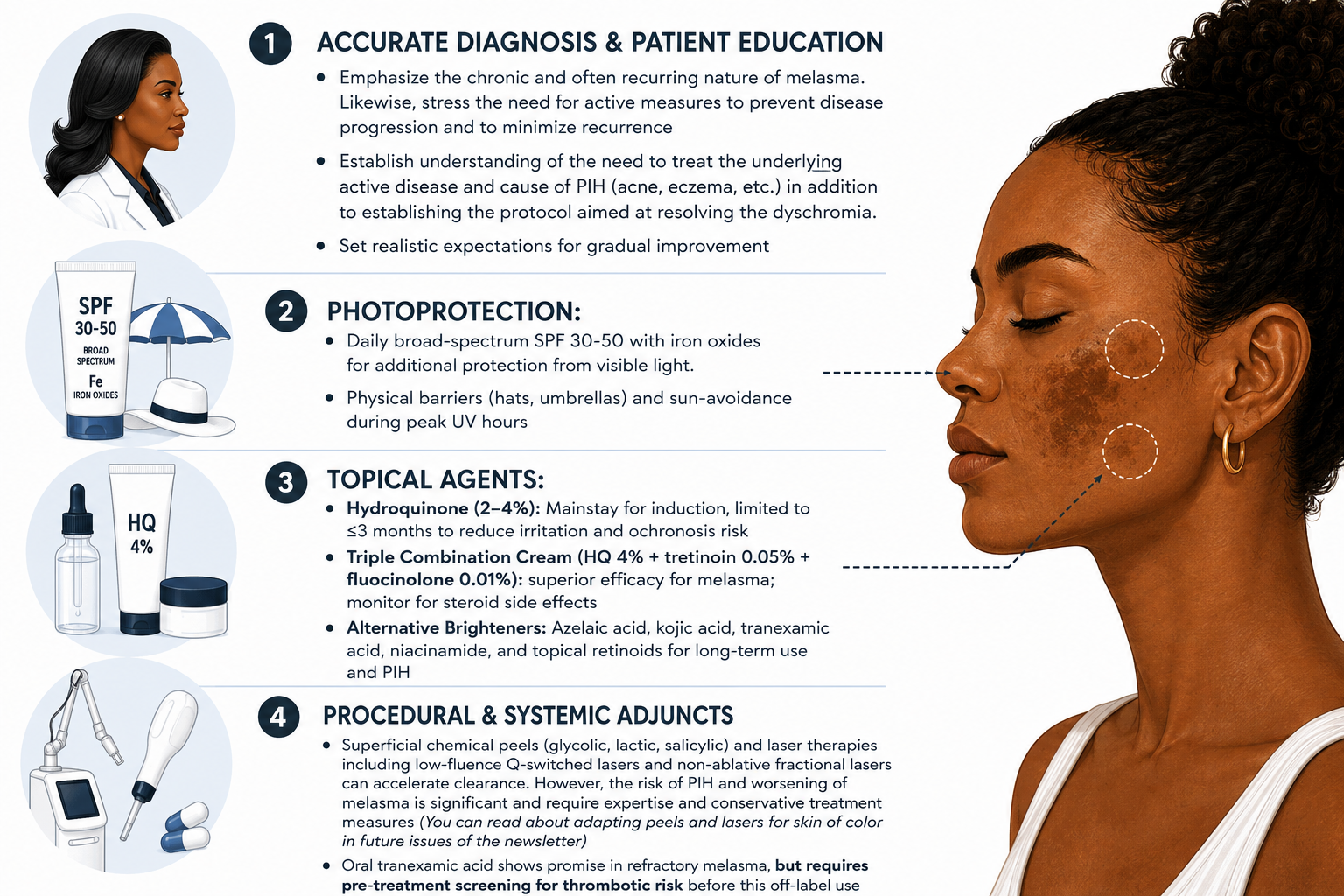
KEY Message:
Successful management of PIH and melasma in skin of color requires a multifaceted, patient-customized approach that balances efficacy with safety. Patients must adhere to consistent photoprotection and maintenance therapy to minimize recurrence.
Common Dyspigmentation in Skin of Color: Acanthosis Nigricans (AN)
Epidemiology & Impact:
Acanthosis nigricans (AN) affects up to 35% of adolescents and 20% of adults in high-risk U.S. populations (obesity and insulin resistance)
Prevalence is markedly higher in Hispanic (20–25%) and Black (25–30%) individuals compared to Caucasians (<5%)
AN’s characteristic hyperpigmented, thickened velvety plaques often on the neck and in the axillae serve as early cutaneous markers for metabolic syndrome and type 2 diabetes, underscoring its systemic importance
Visual Assessment Tools:
Clinicians can use the Modified Acanthosis Nigricans Severity Scale (MANSS), to assess texture, thickness, and pigmentation across nine anatomical sites
A simplified Neck-Only AN Scale correlates strongly (r=0.89) with MANSS and can streamline monitoring in primary care settings
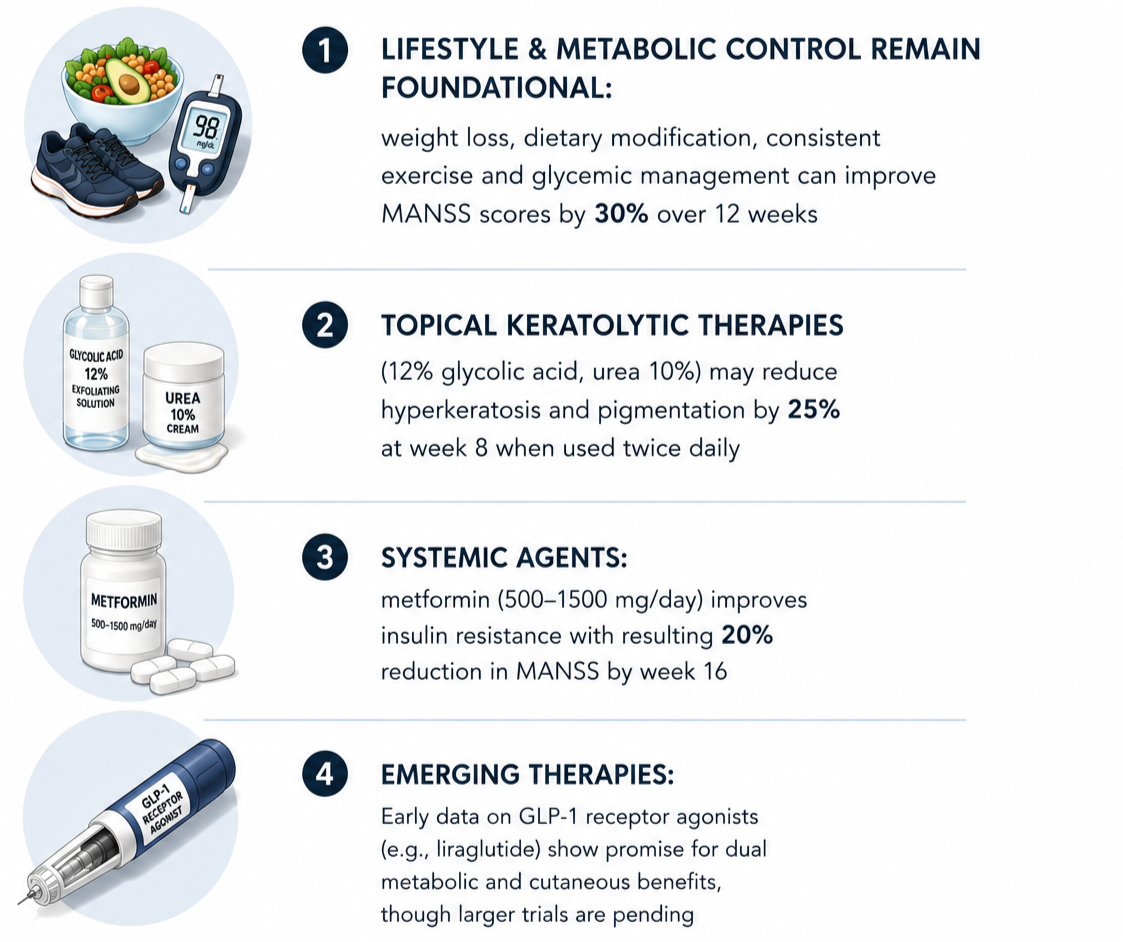
Therapeutic Implications:
KEY MESSAGE:
Acanthosis nigricans is both a cutaneous and metabolic red flag, especially in people of color. Utilizing validated visual scales like MANSS can track treatment response objectively. Combining metabolic interventions with topical keratolytic agents yield the best outcomes. Early identification and a multidisciplinary approach are key to improving both skin appearance and systemic health.
Korean Skincare and Hyperpigmentation: A Gentle, Effective Approach
Korean skincare has gained global recognition for its layered yet gentle routines and innovative ingredients. Its unique qualities make it especially appealing for managing hyperpigmentation which remains a universal concern in skin of color. Rather than relying on harsh bleaching agents, Korean skincare emphasizes hydration, barrier repair, and gradual brightening. This philosophy aligns well with the needs of melanin-rich skin that is prone to post-inflammatory hyperpigmentation (PIH) and melasma.
Impact on Hyperpigmentation:
Hyperpigmentation occurs when the skin produces excess melanin. The excess production of pigment in the skin is often multifactorial in nature and triggered by various sources including sun exposure, prolonged heat, inflammation (like acne or eczema), or hormonal changes. Korean skincare addresses these root causes by focusing on prevention, soothing inflammation, and protecting the skin barrier.
Key Ingredients:
Niacinamide — reduces melanin transfer, calms inflammation and improves barrier function
Licorice root extract — soothes inflammation and lightens dark spots
Centella asiatica — anti-inflammatory action promotes healing and reduces redness
Snail mucin — containing hyaluronic acid and antioxidants which promote skin health and moisturization
A growing body of clinical evidence provides support for use of these various ingredients in daily skincare regimens

Dr. Ginn’s Pearls:
Long-Term Melasma Management and Patient Adherence
TREAT THE VASCULAR COMPONENT - EVEN WHEN YOU CAN'T SEE IT
It’s increasingly recognized that melasma has a vascular component. Erythema is often more difficult to detect in darker skin tones, so it may go unrecognized. I always recommend treating for vascular proliferation when addressing melasma in skin of color. Ingredients such as tranexamic acid (TXA), azelaic acid, and vitamin K oxide are particularly effective for this purpose.
PROACTIVE PREVENTION - EVEN BEFORE PREGNANCY
Being proactive is key. When a patient tells me she’s trying to conceive, I prescribe a tailored skincare regimen that begins beforeconception and continues throughout pregnancy. The focus is on ingredients that reduce inflammation, control excess melanin production, and manage erythema. My go-to options include azelaic acid, niacinamide, and licorice root extract.
CUSTOMIZE AND LAYER TREATMENT PROTOCOLS - OFFICE PROCEDURES + HOME CARE
My treatment approach includes a combination of in-office procedures such as chemical peels, microneedling, and low energy laser treatments paired with a long-term home skin care routine. I emphasize continued use of natural lightening agents after discontinuing hydroquinone, which I use cautiously and with strict time limitations.
DAILY SUN + HEAT PROTECTION IS NON-NEGOTIABLE
Reminding patients to use daily sunscreen, preferably formulations containing iron oxide, is essential. For active individuals who exercise regularly, I recommend quick, frequent breaks during intense workouts to apply cool cloths or soothing facial spritzes to help regulate skin temperature and reduce heat-induced triggers of melasma.
EDUCATION IS KEY
I help patients understand that melasma is a chronic condition, much like diabetes. Drawing that parallel helps them grasp the importance of long-term management. Both conditions require consistent effort and commitment to control symptoms and minimize the impact on quality of life.
Setting Realistic Patient Expectations and Treatment Timelines for Dyspigmentation
Managing dyspigmentation whether melasma or post-inflammatory hyperpigmentation in skin of color is a marathon, not a sprint.
Here’s what patients should know:
REALISTIC PATIENT EXPECTATIONS:
Improvement is gradual. Noticeable changes often begin around 4–6 weeks, with more visible effects by 3 months
Expected results and timelines differ dependent on treatment modality
Complete “return to baseline” is uncommon; patients typically achieve 30–70% pigment lightening.
Maintenance is lifelong. Relapses occur if photoprotection or topical therapies are discontinued
Multifaceted regimens yield better outcomes than monotherapy: combining sunscreens, topicals, and procedural approaches maximizes clearance
KEY MESSAGES:
Set realistic goals as dyspigmentation improves but rarely “cures”
Measure success in 2 ways: brightening and blending of skin and no new or worsening dark patches over time
Emphasize strict, daily photoprotection (broad-spectrum + iron oxides) to prevent relapse
Encourage long-term adherence: even after clearance, reduce therapy frequency but never fully stop
Regular follow-up every 2–4 months helps reinforce regimen, manage side effects, and adjust treatments
A dermatologist with experience in treating dyspigmentation in skin of color can provide patients with the treatment most suited to individual symptoms and skin tone
REFERENCES AND RESOURCES:
Psychosocial Impact of Dyspigmentation
The Psychosocial Burden of Skin Disease and Dermatology Care Insights Among Skin of Color Consumers
Cartwright et al., J Drugs Dermatol. 2023;22(10):1027-1033 doi:10.36849/JDD.7713
Melasma and PIH:
CME: Therapeutic Insights in Melasma and Hyperpigmentation Management
Huerth et al., J Drugs Dermatol. 2019;18(11)
Best Practices in the Treatment of Melasma with a Focus on Patients with Skin of Color
Alexis et al., J American Academy of Dermatol. 2024; 90 (2): 269-279
Topical Treatments for Melasma: A Systematic Review of Randomized Controlled Trials
Austin et al., Am J Clin Dermatol 21, 173–225 (2020).
Best practices in the treatment of melasma with a focus on patients with skin of color
McKesey et al., J American Academy of Dermatol. 2024; 90 (2): 269-279
Acanthosis Nigricans:
Visual Assessment Tools & Therapeutic Implications for Acanthosis Nigricans
Bitterman et al,. J Drugs Dermatol. 2025;24(7):816–824. DOI:10.36849/JDD.2025.816
Korean Skincare:
Bioactive ingredients in Korean cosmeceuticals: Trends and research evidence
Nguyen et al., Journal of Cosmetic Dermatology, 26 Feb 2020, 19(7):1555-1569