
Chemical Peels in Skin of Color: What You Need to Know
CONTRIBUTOR: Dr. Heather Woolery-Lloyd, MD, FAAD
Overview
Dr. Heather Woolery-Lloyd, board-certified dermatologist and Director of the Skin of Color Division at the University of Miami Department of Dermatology, shares clinical guidance on the safe and effective use of chemical peels in patients with skin of color. This publication explores evidence-based peel selection, conservative treatment protocols, and pre- and post-procedure care to minimize the risk of post-inflammatory hyperpigmentation and scarring, while also addressing the growing popularity of at-home chemical peels and practical strategies for counseling and managing patients who experience complications.
A message From OUR COUNCIL:

Dr. Heather Woolery-Lloyd
“When tailored appropriately - selecting gentler agents, priming, staged treatments, and rigorous aftercare - chemical peels can safely address pigment and texture concerns in skin of color with minimal complications. Collaboration with experienced practitioners and patient education remain paramount.”
Adapting Facial Chemical Peels:
Facial chemical peels are highly effective for treating dyschromias, acne, and photoaging. However, melanin-rich skin (Fitzpatrick IV-VI) is predisposed to post-inflammatory hyperpigmentation (PIH) and other adverse reactions. Adapting peel choice, regimen, and aftercare can optimize safety and outcomes for skin of color. When tailored appropriately — selecting gentler agents, priming, staged treatments, and rigorous aftercare — chemical peels can safely address pigment and texture concerns in skin of color with minimal complications. Collaboration with experienced practitioners and patient education remain paramount.
Selecting the Right Peel:
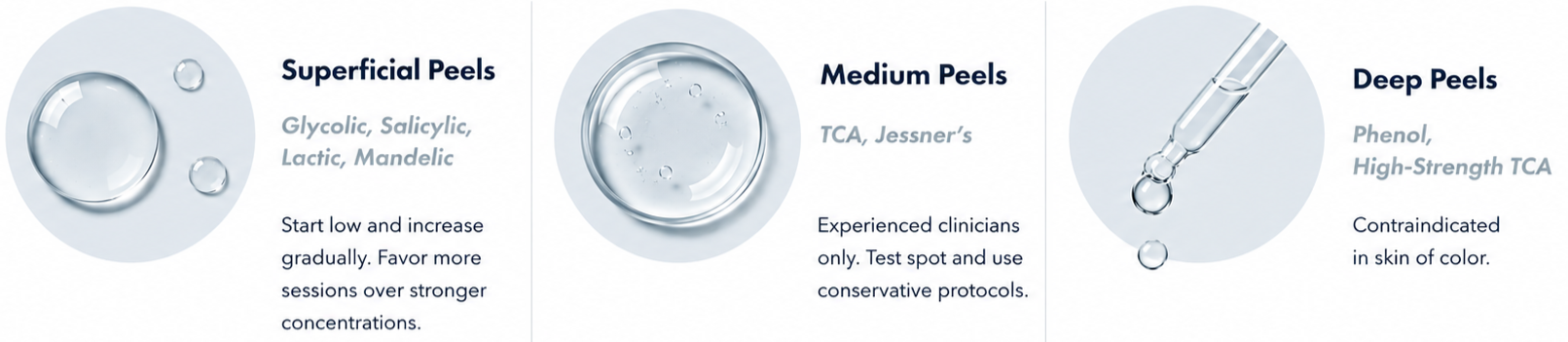
The Risks of At-Home Chemical Peels
While DIY chemical peels have become increasingly accessible through online retailers and social media tutorials they present a real risk of skin damage for patients. Convenience, cost savings, and the rise of beauty influencers have driven consumers to experiment with at-home peels.
Platforms like TikTok and Instagram fuel the misperception that DIY peeling is both effective and low risk. There have been multiple cases of chemical burns and scarring from DIY peels, and the FDA issued a warning in July 2024 about the rise of at-home peels. The FDA has not approved any at-home peel products and recommends using peels only under the supervision of a dermatologist.
It is important to be aware of this new trend especially when seeing patients who present with hyperpigmentation from an at home procedure. You should advise patients considering at-home peels to think again. Management can be a challenge especially in more severe cases and includes hydroquinone and cosmeceutical agents for hyperpigmentation.
Dr. Heather Woolery-Lloyd’s
Peel Guidelines for Skin of Color
Patient Education: Pre- and Post-Care for Chemical Peels:
Proper patient education ensures safety, maximizes outcomes, and minimizes complications. Before treatment, patients must understand how to prepare their skin, what to expect immediately after, and how to care for it through the healing phase. Clear guidance reduces anxiety and empowers patients to participate actively in their own recovery.
Clear patient communication is essential, as noticeable improvement often requires a series of treatments rather than a single session
Superficial peel protocol for dyschromia and /or acne - Peel every 3-4 weeks for a series of 5-6 peels
Pre-Care Guidelines:
Patients should begin preparing their skin 1–4 weeks before a peel. Key steps include:
Discontinue exfoliating agents.
Stop retinoids, alpha-hydroxy acids, salicylic acid, vitamin C, and hydroquinone 3-7 days pre-treatment.
Avoid procedures that irritate the skin. No waxing, electrolysis, depilatories, laser hair removal, or waxing within one week of the peel.
Sun protection. Use broad-spectrum SPF 30+ daily and avoid tanning beds or prolonged sun exposure.
Antiviral prophylaxis (if indicated). Patients with a history of herpes simplex should start antiviral therapy as directed by their clinician.
Skin priming. Consider hydroquinone or azelaic acid to suppress melanocyte activity and improve peel uniformity.
During Procedure:
During application, Dr. Woolery-Lloyd recommends using rough gauze instead of sponges to minimize product waste and provide gentle exfoliation. A handheld fan can alleviate stinging and if a frost occurs, consider a low potency topical steroid in office and at home for up to five days to decrease inflammation and lower the risk of hyperpigmentation.
Post-Care Guidelines:
Gentle cleansing and generous application of moisturizers. Use a mild, non-foaming cleanser and apply moisturizer at least twice daily; avoid mechanical exfoliation for 7-10 days.
No picking or peeling. Discourage manual removal of flaking skin to reduce the risk of post-inflammatory hyperpigmentation (PIH)
Strict photoprotection. Apply sunscreen (SPF 30+) every morning; tinted, mineral formulations can also block visible light–induced PIH
Activity restrictions. Avoid excessive sun exposure post peel
Addressing Downtime Concerns:
Set realistic expectations. Explain the typical timeline: redness for 1-3 days, peeling 3-7 days, full recovery by 10-14 days depending on peel depth.
Offer graded options. Highlight that superficial peels have minimal downtime (hours to 2 days) versus medium peels (4-7 days)
Scheduling around events. Encourage timing treatments at least 2-3 weeks before important occasions to allow complete healing
Providing “survival kits.” Assemble post-care kits with cleanser, moisturizer, sunscreen, and cooling compresses to ease discomfort
Follow-up support. Schedule a touch-base call or visit within 48-72 hours to assess healing, address concerns, and reinforce adherence.
rESOURCES AND REFERENCES
Peels in Skin of Color:
Cosmetic Procedures in Patients with Skin of Color: Clinical Pearls and Pitfalls, J Clin Aesthet Dermatol. 2023;16(3):37–40.
An update on cosmetic procedures in people of color. Part 2: Neuromodulators, soft tissue augmentation, chemexfoliating agents, and laser hair reduction; Quinonez et al, J Am Acad Dermatol 2022;86:729-39
Safety in Skin of Color:
Assessing the safety of superficial chemical peels in darker skin: A retrospective studyVemula S, et al, J Am Acad Dermatol. 2018 Sep;79(3):508-513
DIY Peels:
FDA warns against purchasing or using chemical peel skin products without professional supervision
Superficial Peels – Practical Implementation:
Dr Heather Woolery-Lloyd, Pigmentary Disorders Exchange Symposium, June 2023