
Follicle Focus: Hair & Scalp Management in Skin of Color
CONTRIBUTOR: Porcia Love, MD
OVERVIEW
This issue of the Treating Skin of Color Micro-Series explores hair and scalp management in patients with skin of color, with a focus on recognizing and managing traction alopecia (TA) and central centrifugal cicatricial alopecia (CCCA). Dr. Porcia Love shares clinical guidance for early diagnosis, addresses common misconceptions surrounding natural oils and hair regrowth, and offers culturally sensitive recommendations for supporting healthy hair and scalp care.
Early Diagnostic Signs and Differential Diagnosis of Traction Alopecia and CCCA in Skin of Color Patients
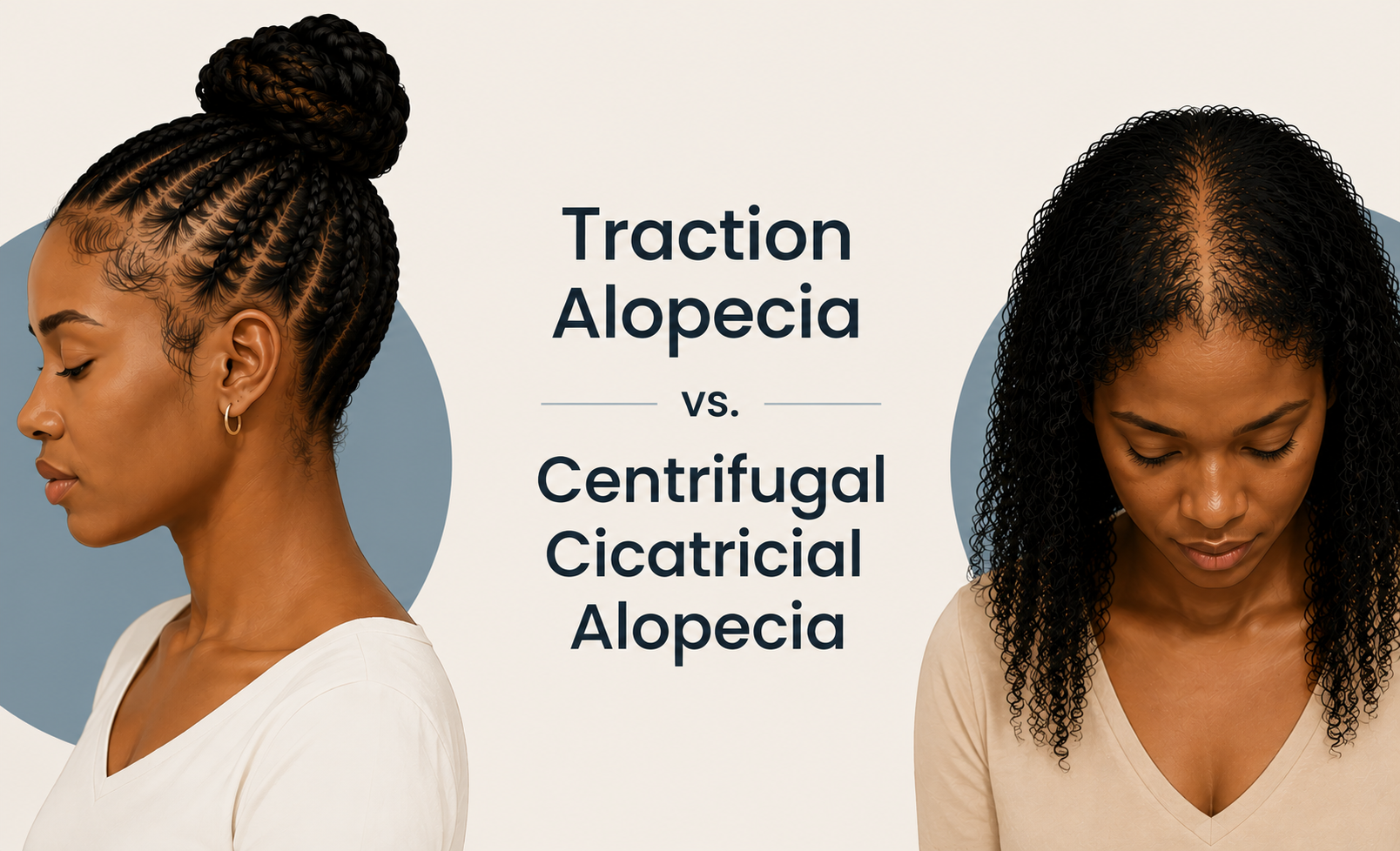
-
Early Clinical Signs
History of tension-inducing hairstyles (tight braids, ponytails, weaves)
Scalp symptoms: itching, redness, scaling, folliculitis-like papules or pustules around hair follicles
“Fringe sign:” preservation of short, broken hairs along the marginal hairline despite adjacent hair loss
Multiple short, broken hairs and thinning localized to areas under mechanical stress
Trichoscopic Features
Perifollicular erythema
Hyperpigmented perifollicular macules
Miniaturized hairs
Preserved follicular openings outlined in brown pigmentation
Histology (Early TA)
Trichomalacia: distorted, thinned hair shafts
Increased catagen/telogen hairs
Preserved sebaceous glands
Mild, perivascular or perifollicular inflammation
Differential Diagnoses for Early Stage
Seborrheic dermatitis: diffuse scaling, greasy yellow‐white scale
-
Early Clinical Signs
Initial hair breakage at the vertex, often unnoticed until diffuse loss spreads centrifugally
Mild tenderness, pruritus, burning, or asymptomatic early on
Smooth, shiny scalp in burned-out areas as disease advances
Trichoscopic Features
Peripilar gray-white halo around emerging hairs
Follicular miniaturization (small, thin hairs)
Loss of follicular openings in advanced areas
Perifollicular scale and erythema in active zones
“Honeycomb” pigmented network interspersed with pinpoint white dots
Histology (Early CCCA)
Premature desquamation of the inner root sheath
Mild to moderate lymphocytic perifollicular inflammation at the infundibulum/isthmus
Concentric lamellar fibrosis (“onion-skin” fibrosis) around follicles
Retained sebaceous glands
Differential Diagnoses for Early CCCA
Traction alopecia: history of tension, preservation of fringe sign
Androgenetic alopecia: diffuse miniaturization, pervertex thinning without significant inflammation
Frontal fibrosing alopecia: frontal hairline recession, eyebrow loss, lonely hair sign, hypopigmented perifollicular erythema
Key Points for Distinction:
-
TA: Repetitive traction hairstyles
CCCA: May have genetic predisposition or haircare practices but lacks acute traction history
-
TA: Often affects marginal hairlines (frontal/temporal), may be symmetric
CCCA: Starts at vertex, spreads in centrifugal pattern
-
TA: Perifollicular hyperpigmentation, preserved follicular openings
CCCA: Loss of openings, peripilar white halo, active perifollicular scaling
-
TA: Non-scarring changes early, eventual fibrosis with prolonged traction
CCCA: Early scarring changes with inner sheath desquamation and fibrosis even in mild disease
-
TA: TEnderness/pain with certain hairstyles
CCCA: Potential comorbidities (uterine leiomyomas, diabetics), family history, scalp smoothness in burned-out zones
Clinical Approach
Conduct detailed history of hairstyling practices, symptom onset, and family history
Perform focused clinical examination: look for fringe sign, hair breakage patterns, scalp texture
Utilize trichoscopy to identify diagnostic signs (e.g., peripilar halo vs. hyperpigmented macules)
If suspicion remains, proceed to punch biopsy from active edge (TA) or early-involved vertex edge (CCCA).
Initiate early intervention:
TA: Eliminate traction, topical steroids or antibiotics if folliculitis present
CCCA: Anti-inflammatories (topical/intralesional steroids), anti-fibrotics, and minimize chemical/thermal damage
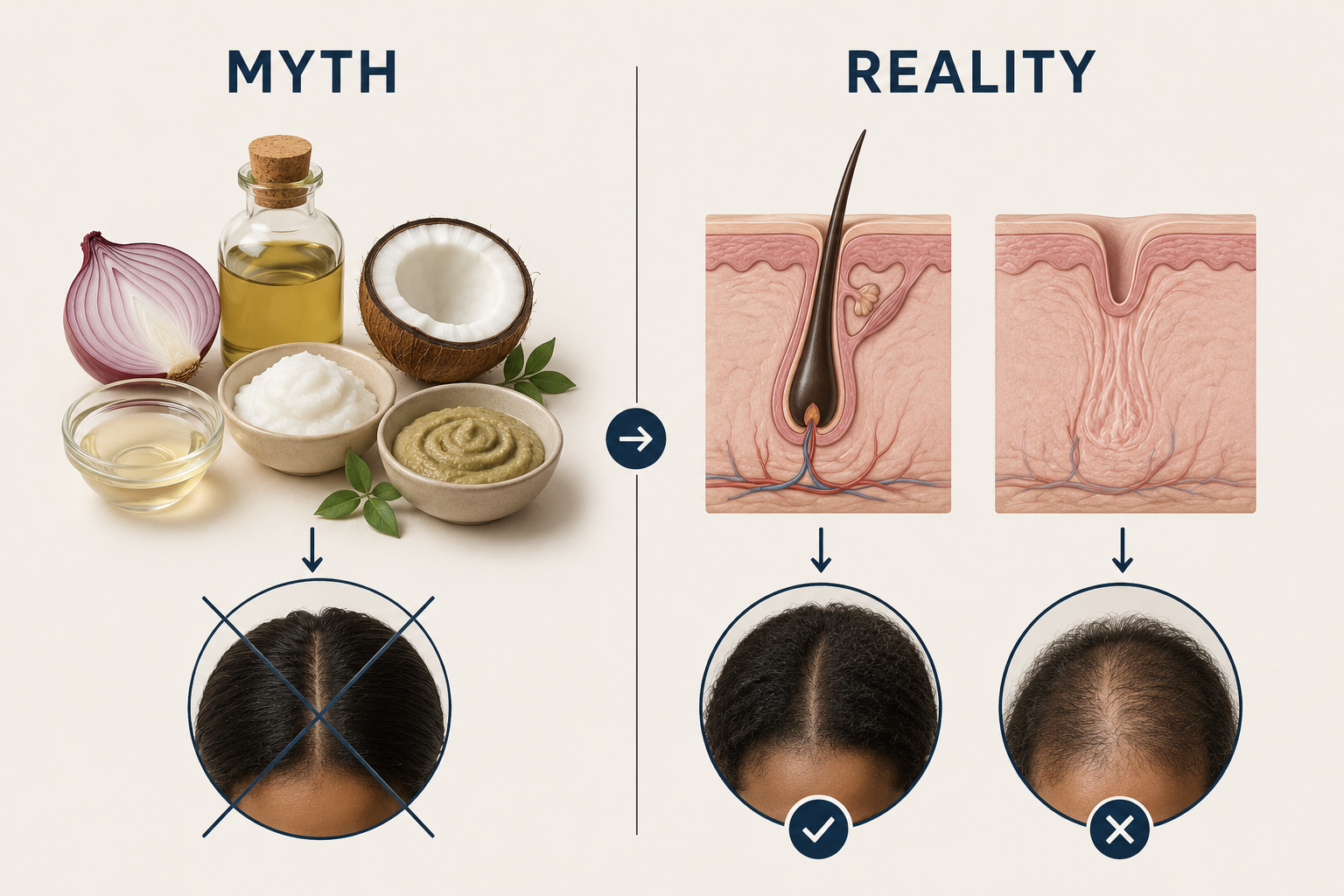
The “Natural Oils and Masks Will Regrow Hair” Myth
Many skin of color patients turn to onion juice, castor oil, coconut oil, and homemade masks - often shared on social media - with the belief that these treatments can reactivate dormant follicles, reverse scarring alopecias, or fully restore hair density. This is by far the most pervasive DIY hair-growth misconception clinicians encounter.
WHY ITS PROBLEMATIC:
Patients may equate “natural” with safe and effective, assuming plant-based ingredients can revive hair follicles, while viral before-and-after results and unstandardized DIY recipes can reinforce this misconception by presenting temporary cosmetic improvements as true hair regrowth.
WHY THIS MYTH PERSISTS:
False expectations around unproven DIY remedies can delay or replace evidence-based treatment for traction alopecia or CCCA, while unregulated mixtures may cause scalp irritation, folliculitis, and post-inflammatory hyperpigmentation and waste time and money without clinical proof of follicle activation.
How Clinicians Can Address It:
Elicit Specific DIY Practices
Ask about home concoctions by name “Are you using onion juice or castor-oil packs?” to tailor your guidanceClarify Mechanism vs. Marketing
Explain that most oils coat and condition the hair shaft—they don’t penetrate the follicle niche or reverse scarring. Use the gym analogy: “Just as protein shakes support muscle health but don’t build muscle on their own, oils help maintain existing hair without re-energizing dormant follicles”Offer Evidence-Based Alternatives
Introduce safe adjuncts—low-dose minoxidil, anti-inflammatory topicals, or in-office modalities like PRP—emphasizing their proven mechanismsValidate and Integrate When Safe
Encourage low-risk habits patients value (gentle scalp massage with mild oils, protective styling) while setting realistic goals and timelines

Dr. Love’s Clinical Pearls on Culturally Sensitive Hair Care Recommendations
Gentle hair care for skin of color balances moisture retention, minimal manipulation, and scalp health
Weekly or biweekly shampooing with a sulfate-free, moisturizing cleanser helps clear sebum and styling buildup without over-stripping oils. Follow with a rich conditioner, letting it sit for 3-5 minutes before rinsing. Section dry or damp hair into four parts and detangle gently from ends to roots using a wide-tooth comb or detangling brush to prevent breakage. Seal in hydration with the LOC method-leave-in conditioner, lightweight oil (e.g., jojoba, grapeseed), then cream.
Protective styling reduces tension and mechanical damage. Recommend loose braids, twists, and buns secured with fabric ties or silk scrunchies instead of rubber bands or metal clips. Advise sleeping on satin or silk pillowcases or wearing a bonnet to preserve moisture and minimize friction overnight. When heat styling is necessary, use a heat-protectant spray and keep temperatures below 300°F.
Effective patient education hinges on empathy and clear visuals. Begin by asking open-ended questions about their “wash day,” styling goals, and cultural practices. Validate time and financial investments in their routines. Use brief, illustrated handouts or smartphone videos to demonstrate sectioning, detangling, and the LOC technique, reinforcing steps during in-office tutorials. Provide an ingredient checklist - humectants like glycerin and emollients such as shea butter - to guide product selection.
Co-create a realistic care plan that integrates low-risk home habits (gentle scalp massage, pre-poo treatments) with clinical therapies as needed. Schedule follow-up visits to adjust recommendations, address concerns, and celebrate progress - fostering trust and adherence in culturally sensitive hair care.
RESOURCES AND REFERENCES
Culturally Sensitive Haircare:
Callender V , Skin of Color Update, 2018
Asbeck S et al., Afro-Ethnic Hairstyling Trends, Risks, and Recommendations. Cosmetics. 2022;
9(1):17.
American Occupational Therapy Association. AOTA’s Guide to Culturally Inclusive Hair Care Services and Incorporating Cultural Humility Into Practice. 2022
DIY Haircare solutions:
Laughter MR, et al., Commonly used over-the-counter therapies for hair growth in skin of color: an evidenced-based review. J Drugs Dermatol. 2021;20(7):726–731
Gentle Haircare
Essential Treatment Tips for Hair of Color
Textured Hair and Skin Color Care